The Nose Must Outweigh Everything the Wind Can Grab
Model Rocketry 🎮 Play: ApogeeI went to the hobby shop for foam and CA glue to fix a glider wing, and left with a starter kit I hadn’t planned to buy, mostly because of a wire rack of little cardboard motors stamped A8-3, B6-4, C6-5. The clerk explained the code in about fifteen seconds — the letter is total impulse, doubling each step; the first number is average thrust in newtons; the last is the ejection delay. That was enough to hook me. But the question that actually followed me home was the one he answered more vaguely: how do you make sure the thing climbs instead of tumbling? The answer is a single geometric relationship, and it’s worth doing properly because getting it wrong turns a rocket into a lawn dart before it clears head height.
Two points on a stick
Every rocket has two points that decide its fate. The centre of gravity (CG) is where it balances — the average of all its mass. The centre of pressure (CP) is where the aerodynamic force effectively acts — the average of all the sideways air load if the rocket is shoved off-axis.
The rule is short: the CP must sit behind the CG. When a gust nudges the nose off-course, the air load lands aft of the balance point and levers the tail back downwind, swinging the nose back into the airflow. Put the CP ahead of the CG and the same gust levers the nose further off — the rocket tumbles.
This is not a new idea to anyone who’s carved a weather vane. Back in April I built a whittled vane whose whole design problem was area behind the pivot, weight ahead of it — a zero-lift aircraft that never lands, permanently trimmed to point into the wind. A rocket is the same machine with the pivot free to move: fins are the tail area, the nose ballast is the forward weight, and “one calibre of static margin” is the model-rocket phrase for what a vane maker calls getting the balance right.
Finding the two points
CG is easy. Load the motor you plan to fly, tape the whole rocket up as if for launch, and balance it on the edge of a ruler. Mark that spot. It has to be the flight-ready CG — the motor is a chunk of mass at the very back, and it shifts the balance meaningfully.
CP is harder to compute but cheap to estimate. Barrowman’s 1966 equations (written for NASA, still the standard) give it precisely from the nose and fin dimensions. For a first build you can skip the algebra with the cardboard-cutout method: trace the rocket’s side silhouette onto stiff card, cut it out, and balance the flat shape on a knife edge. The point where the silhouette balances is the centroid of side area — a deliberately conservative stand-in for the CP. It always errs slightly forward of the true CP, which biases you toward stability. Good enough for a first flight.
Mark both points on the actual rocket. The distance between them, measured in body-tube diameters, is your static margin. Aim for one to two calibres: CP one to two tube-widths behind CG.
The swing test, which requires no math at all
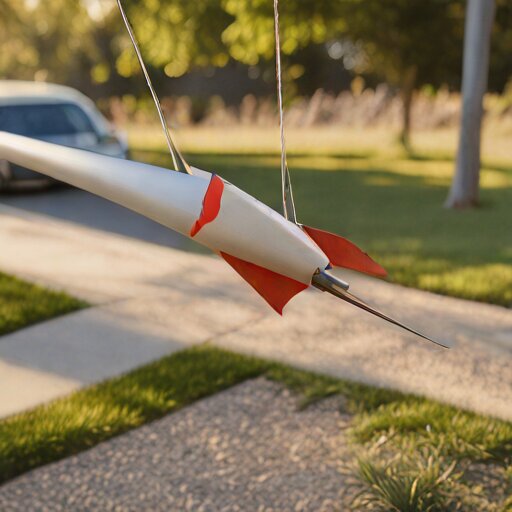
Tie a loop of string around the rocket exactly at the marked CG. Lift it, let it hang level, then walk in a slow circle so the rocket swings around you on the string like a tetherball.
- If it swings nose-first, the CP is behind the CG. It will fly.
- If it swings sideways or tail-first, or won’t settle, the CP is too far forward. Add nose weight (clay in the nose cone) and test again.
That’s it — a full analog stability solver, no calculator, the same trick fliers used in 1960. It works because the swing forces air over the rocket at the CG, exactly reproducing the gust case.
One caution the swing test won’t warn you about: too much margin is its own failure. An over-stable rocket weathercocks aggressively, turning hard into any crosswind and flying a long shallow arc downrange instead of up — precisely the behaviour I wanted from the weather vane and precisely what I don’t want from a rocket. Three calibres and it’ll try to fly to the next township.
My first kit is a stubby three-finned thing on a B6-4, nose cone packed with a pea of modelling clay until the cardboard silhouette balanced a full tube-width behind the loaded CG. It swings nose-first on the string, reliably, which is the only test I’ve actually passed so far. Whether the ejection charge pops the chute at apogee instead of on the way down is Thursday’s problem, and the delay grain is already chosen. The arithmetic says it flies. The prairie gets a vote too.